-
Call Us Now
1-888-758-4646
-


- OUR APPROACH
-
COMMITTED TO YOUR SUCCESS
Our approach, developed over decades of experience, is fine-tuned to get the results you want.
We deliver concept-to-completion solutions, designed by temporary power specialists with access to the largest inventory of high-quality power generation and distribution equipment in North America.
-
- Equipment
-
RENTALS
From a wide range of diesel and natural gas generators to transformers, cable, light towers and more, our large rental fleet and extensive vendor network ensure we’ll have the temporary power equipment that your project requires — every time.
- Industries
-
INDUSTRIES WE SERVE
For nearly 20 years, we have been at work powering projects across Canada’s industrial sectors.
Select from this sampling of industries to learn how we can put our expertise to work for you.
VIEW ALL- Projects
- About
-
A PROUD HISTORY. A BRIGHT FUTURE.
From our inception in 1998, we have been building our team on a foundation of excellence. Our team members’ passion, expertise and commitment are what have allowed us to grow into a national company with projects across Canada.
Click on the links to learn more about our history, our team or our career opportunities.
- Blog
- Contact
Data Center Expansion: Why Mobile Substations Accelerate Your Deployment Timeline
Jul 28, 2026
Utility interconnection queues, transformer procurement delays and grid capacity constraints are pushing energization dates years beyond build-ready milestones. Your facility construction timeline might be on track, but grid connections can add 18 months or more. Canada’s hyperscale data center market is expected to reach $10.21 billion U.S. dollars by 2031 at a 22.07% compound annual growth rate (CAGR), and demand is outpacing available power at every level. Mobile substations close that gap. Pre-engineered, pre-tested and deployable in days, they deliver power on your timeline — not the utility’s.
Why Permanent Power Infrastructure Can’t Keep Pace With Data Center Growth
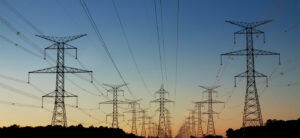
Permanent power infrastructure can’t keep up with data center growth due to utility interconnection queues in Canada and transformer and substation equipment lead times. Your building can go up quickly, but utility interconnection and substation equipment procurement now stretch years beyond that. The gap isn’t closing — it’s widening as electrification projects and housing development compete for the same grid capacity.
Utility Interconnection Queues in Canada
A recent market report found that new 50 megawatt (MW) connections can face 18 to 36 month wait times as substation upgrades compete with transit and housing projects. In North America, projects currently take about five years from interconnection request to commercial operation. Limited spare grid capacity forces projects onto hold while infrastructure upgrades proceed, and those upgrades carry escalating costs that can threaten project viability.
The report also noted Lower Mainland congestion, where data center requests compete with mining electrification and electric vehicle (EV) charging projects. In fact, developers unable to secure firm power are deferring construction or splitting builds into 10 MW slices to fly under expedited-review thresholds.
Transformer and Substation Equipment Lead Times
Even when interconnection is approved, procurement timelines for permanent substation gear add another multiyear layer. Average transformer lead times have increased from 50 weeks in 2020 to nearly two years for units exceeding 100 megavolt-ampere (MVA). Grid connection timelines for new data centers now stretch as long as seven years in some jurisdictions — a delay that renders conventional planning timelines obsolete.
Advantages of Mobile Data Centerdata center infrastructure Substations
Mobile substations eliminate the procurement and interconnection bottleneck by delivering pre-engineered power distribution on your schedule. For projects where permanent data center infrastructure won’t be available for years, rental units provide the bridge that keeps your expansion on track.
1. Rapid On-Site Deployment
Mobile substations reduce deployment timelines from years to days. Factory pre-assembly, plug-and-play modularity and streamlined logistics enable installation within days, compared to the multiyear timelines for conventional permanent substations. Pre-engineered and prefabricated modular substations arrive tested and ready for energization. There’s no on-site fabrication or extended commissioning windows.
When your project can’t wait for the utility queue to clear, packaged substation rentals deliver power infrastructure that matches your construction schedule.
2. Pre-Tested, Plug-and-Play Commissioning
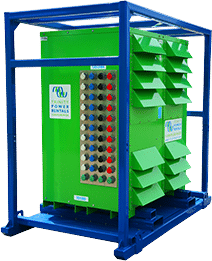
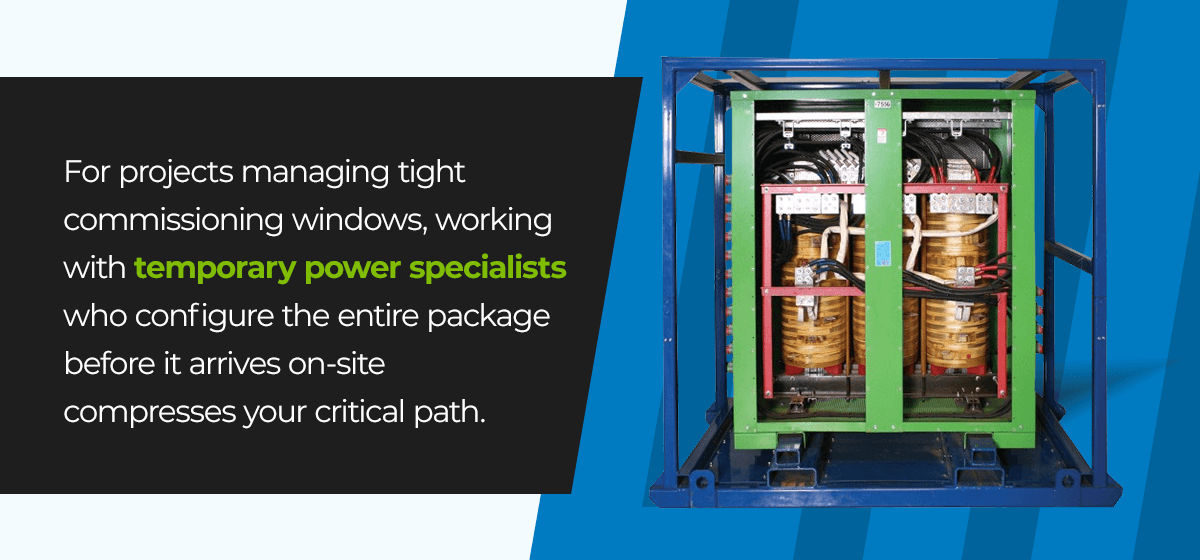
Factory pre-assembled and pre-tested units eliminate on-site integration surprises. Integrated systems bring together medium voltage and low voltage switchgear, step-down transformers and prewired interconnections. This simplifies site work and reduces commissioning risk. One vendor handles equipment, delivery and configuration, providing turnkey power solutions that streamline coordination across your project.
For projects managing tight commissioning windows, working with temporary power specialists who configure the entire package before it arrives on-site compresses your critical path.
3. Scalable Capacity for Phased Buildouts
Mobile substations support multi-voltage operation and modular scalability, making them well-suited for phased expansion. Right-size capacity for each phase, redeploy units as needs evolve and remove them once permanent power infrastructure comes online. Compact footprint — 60 square metres for a 40 MVA unit — minimizes land use during active construction.
The rental model eliminates long-term capital commitment. Scale capacity up or down without purchasing equipment that may not align with future phases. For projects deploying medium voltage transformers across multiple phases, rental flexibility matches the uncertainty inherent in staged expansion.
How to Choose the Right Power Strategy for Each Expansion Phase
While data centers can be built quickly, permanent transmission and substation infrastructure can take several years. That gap is exactly where mobile power makes sense. For projects where your expansion phase involves long utility interconnection queues or extended equipment lead times, mobile substations keep construction moving forward while you wait for firm grid capacity.
You can especially benefit from a phased mobile substation deployment if you’re splitting builds into smaller phases to work around firm power constraints. You can deploy your rental units to energize each phase independently, then transition to permanent power as grid capacity becomes available. This approach lets you book revenue from completed phases years before permanent infrastructure would otherwise allow. Mobile substations serve as bridge power — operational during expansion phases, then redeployed or removed as utility connection delays resolve and permanent systems come online.
For facilities planning multiyear expansion timelines, the decision framework is straightforward. If your next phase needs power before permanent infrastructure is feasible, mobile substations deliver the speed and flexibility your timeline demands.
Tips for Protecting Uptime During Active Data Center Expansion
Deploying mobile substations around running systems requires coordination to keep construction activity isolated from live loads. Consider these tips when planning expansion phases:
- Map electrical isolation points before delivery: Identify where new power feeds can connect without requiring shutdowns or modifications to existing distribution gear. Mobile substations work best when they can energize expansion zones through entirely separate pathways.
- Stage delivery and installation during low-demand windows: Coordinate equipment arrival and placement with your facility team to avoid peak operational periods. Even non-disruptive work benefits from scheduling flexibility when site access is less constrained.
- Establish clear physical boundaries between construction and production zones: Use barriers, signage and access controls to prevent construction activity from encroaching on operational areas. Segregating work zones reduces the risk that installation errors affect live systems.
- Test commissioning sequences offline before connecting loads: Pre-tested units arrive ready to energize, but validating interconnections and protection schemes before bringing expansion capacity online confirms that new infrastructure won’t introduce faults into existing electrical systems.
When permanent infrastructure isn’t an option on your timeline, rental units power your data center without compromising the reliability standards your customers expect.
Power Your Canadian Data Center Expansion With Trinity Power
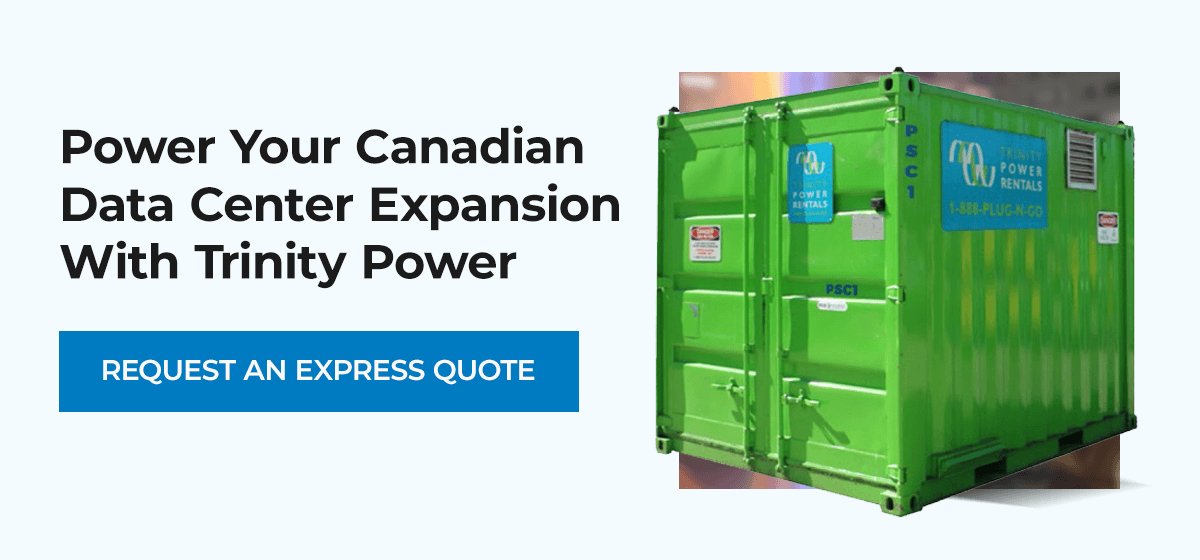
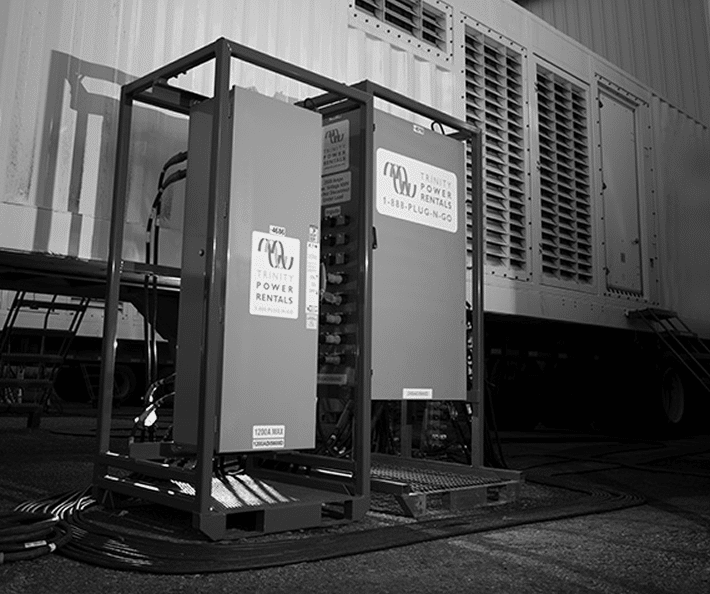
For data center operators who can’t wait years for permanent grid connections, rental power infrastructure offers a proven alternative. We power data center projects across Canada with rental equipment built for speed and reliability. Our fleet includes packaged substations, generators, medium voltage transformers, cables and transfer switches — everything you need from one source.
We’ll configure the right rental substation solution for your timeline, whether you’re bridging a utility delay or scaling through phased expansion. Tell us about your project, and we’ll match you with the equipment that keeps your deployment on track. Contact us to speak with our temporary power specialists today.
Subscribe for Access to Exclusive Content
Get insider updates, industry news, special equipment offers, and expert tips—directly to your inbox.
"*" indicates required fields
For Your Planned &
emergency power needsWe use cookies to improve your experience on our site. By continuing to browse, you agree to our Privacy Policy and Cookie Policy. - Industries
-










 CALL 1-888-758-4646